
Florence and the art of preserving time
destinations
In Florence, history lives on in Renaissance palazzi, in the proportions of a piazza, in artisan workshops and art collections. It is not a static presence, but a living part of the city’s identity.
Perhaps this is one of the reasons why the Biennale Internazionale dell’Antiquariato feels so naturally at home in the Tuscan capital. From 26 September to 4 October 2026, Palazzo Corsini will host the 34th edition of BIAF, once again bringing dealers, collectors and scholars to the heart of Florence, gathered around works that span centuries, artistic languages and ways of life.
To preserve an ancient object, to study it or welcome it into a collection is to recognise its ability to endure through time.
And it is precisely around this idea — the preservation of time — that antiques, collecting and historic residences seem to converge.
The story of the Biennale has its roots in the 1950s, a period marked by remarkable economic and creative momentum. In 1953, Luigi Bellini first envisioned bringing together the finest examples of Italian antiques in Florence.
Six years later, his sons Mario and Giuseppe, together with the Associazione Antiquari d’Italia, founded that same year, brought the first edition of the event to life. It would become one of the most significant gatherings of its kind in the world, attracting not only Italian dealers but also an international elite who saw in Florence the spirit and image of humanist culture: a cultivated and passionate revival of ethical, aesthetic and spiritual values.
The chosen setting was Palazzo Strozzi, a building steeped in history and recognised worldwide as one of the great expressions of the Italian Renaissance. The palace soon became both the emblem of the Biennale and a powerful vehicle for its international reputation.
The executive committee of the inaugural edition was chaired by Giacomo Devoto, linguist, philologist and literary critic, who identified a dual purpose for the event: to broaden appreciation of historic Italian art — from painting and sculpture to furniture and decorative arts — while also acknowledging the commercial dimension of the antiques trade, which played a meaningful role in Italy’s economic development between the 1950s and 1970s.
The Biennale substantially changed the perception of the antique dealer: no longer simply a finder of old objects, but a sophisticated connoisseur of the forms and colours through which art has expressed itself over time.
In the years that followed, the event gradually extended its presence across the city through historical re-enactments and society occasions, attracting an increasingly diverse audience. No longer reserved for specialists and collectors alone, it also became a fixture for the new bourgeoisie that had emerged during Italy’s post-war economic boom.
After several changes of venue, the Biennale found its permanent home in 1997 at Palazzo Corsini on the Arno, a place where history, art and urban life naturally overlap.
Today, the Biennale Internazionale dell’Antiquariato is regarded as the world’s foremost market exhibition devoted to historic Italian art. Every two years, it brings together in Florence a selection of leading Italian and international dealers presenting a broad range of works, each subject to authoritative vetting.
Small but significant temporary exhibitions have also become part of the Biennale’s tradition. Conceived for a wider audience and staged within Palazzo Corsini, they bring together masterpieces from public and private collections. Awards are also presented to particularly notable works exhibited during the event, as well as to figures recognised for their cultural contribution.
A visit to the Biennale therefore becomes a way of reading Florence not simply as the guardian of an extraordinary artistic legacy, but as a city in which past and present continue to engage with one another.
The same idea of preserving time — embodied by works of art in the world of antiques — takes another form at Grand Hotel Baglioni: that of a historic residence that remains very much alive.
Set at the gateway to Florence’s historic centre, the hotel occupies a 19th-century building of almost museum-like character, originally conceived as a princely residence and shaped by more than a century of hospitality.
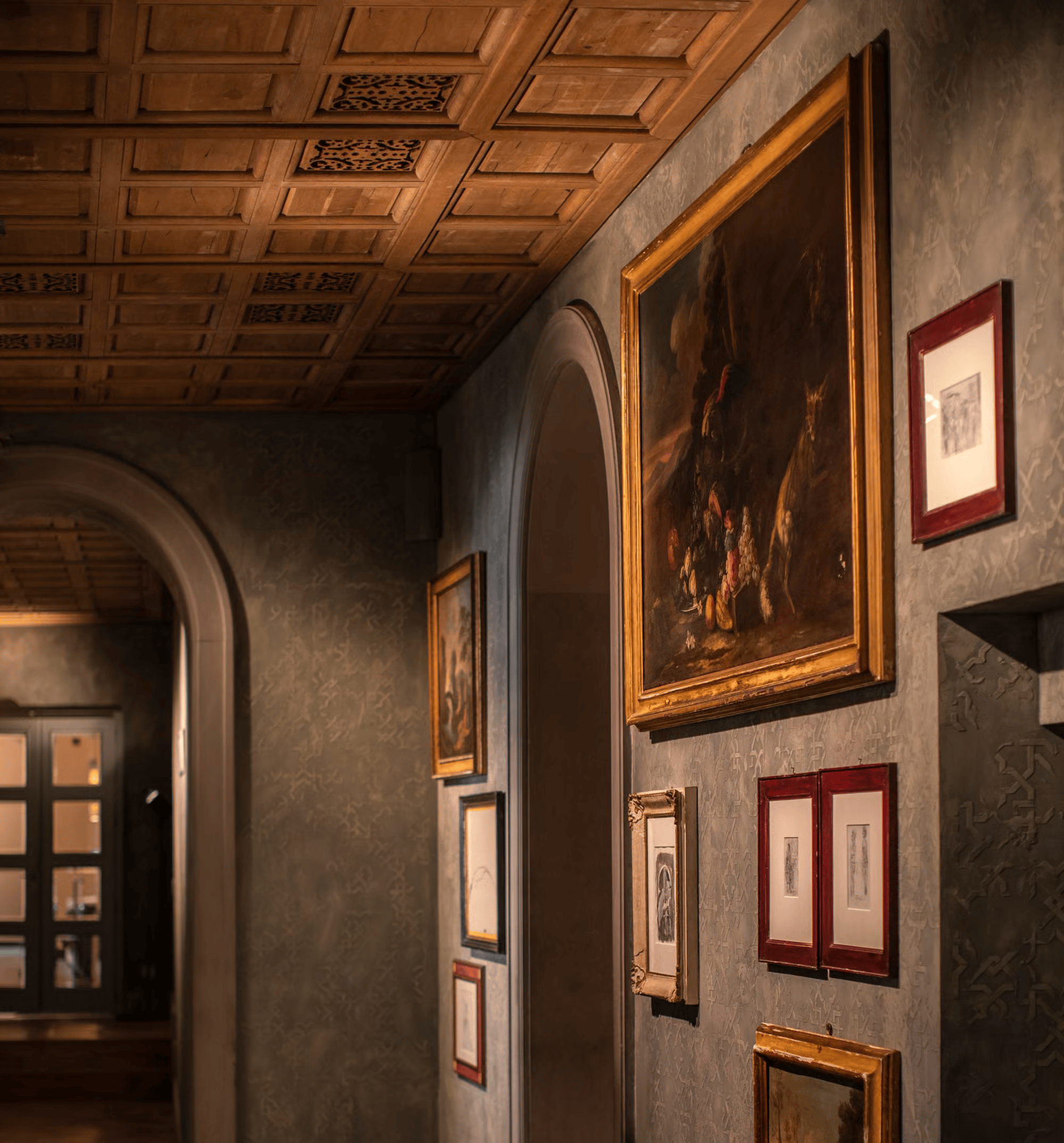
Here, memory remains tangible. It can be felt in the proportions of the rooms, conceived according to another era’s idea of living; in the original materials, textiles and decorative details that echo Florentine tradition; and in the light that filters through the interiors, shaping them in a Caravaggesque interplay of brightness and shadow. The effect lends depth to the spaces and creates the sense of intimacy that only historic residences can offer.
At Grand Hotel Baglioni, history becomes part of the experience of inhabiting a place.
Just as an antique survives through time because someone has chosen to care for and preserve it, a historic building retains its identity by continuing to be lived in, without surrendering the elements of its past that still define it.
Palazzo Corsini and Grand Hotel Baglioni both belong to the historic fabric of central Florence, a city that naturally invites exploration on foot. A visit to the Biennale can therefore become part of a wider itinerary, in which works of art, architecture and the city itself each tell, in their own way, of the continuity between past and present.
Yet the most compelling connection between the Biennale and the Baglioni is not simply geographical.
It is a shared language.
On one side are works that have travelled through centuries and passed from one owner to another before reaching us today. On the other stands a historic building that continues to fulfil its original vocation as a place of hospitality, while preserving the memory embedded within its rooms.

