
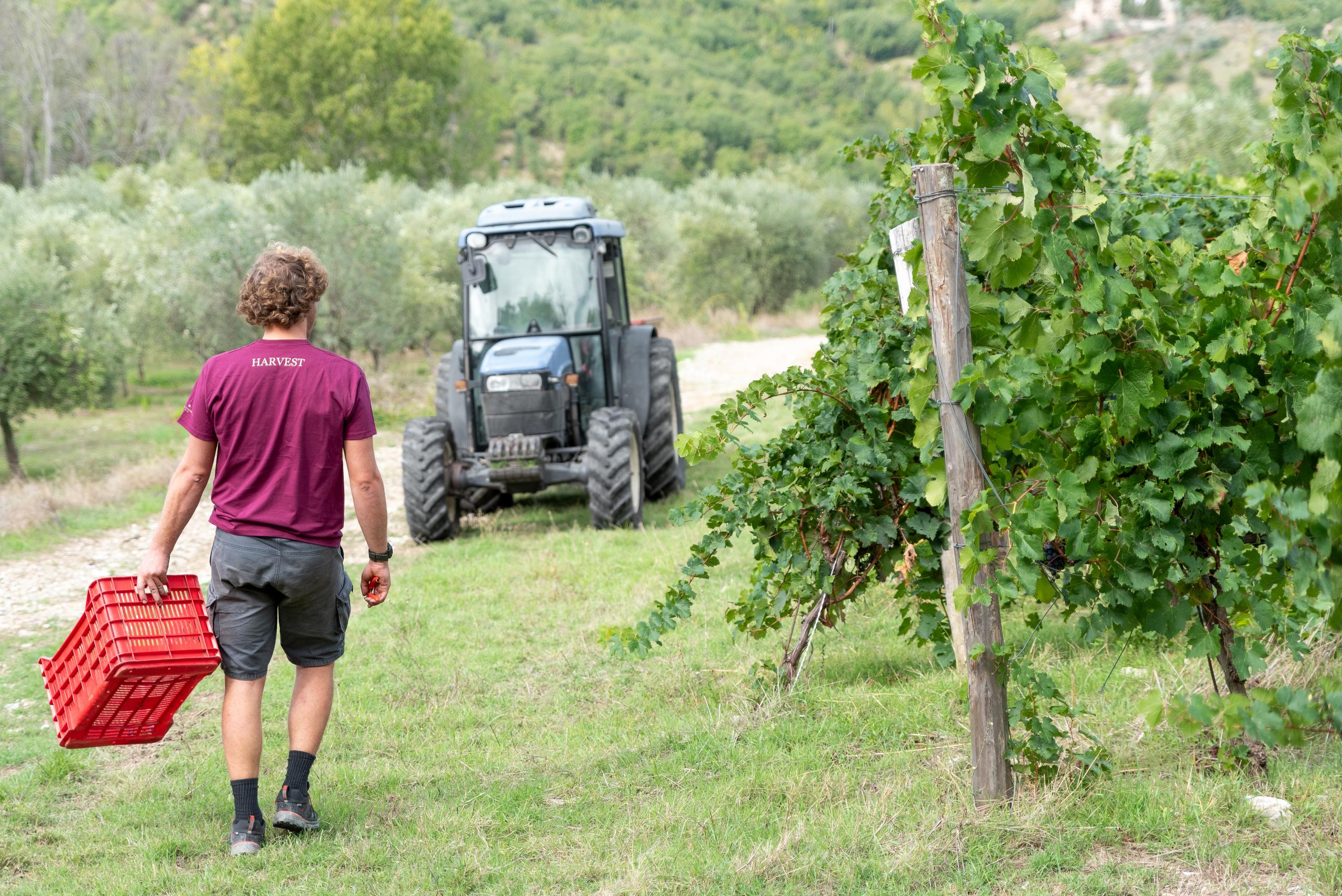
Harvest time: Tuscany’s ancient rural knowledg
enogastronomy
Autumn is one of the most rewarding seasons in which to discover Chianti.
The hills begin to change colour: vineyards, olive groves and woodlands take on warmer tones, while the softer light ushers the landscape into harvest season.
After the liveliness of summer, the villages return to a quieter rhythm and become ideal starting points for walks among ancient parish churches, monasteries and Etruscan necropolises — traces of the area’s deeper history.
Yet it is in the vineyards and olive groves that autumn reveals one of the most authentic expressions of Chianti’s rural culture. This is the season of the grape harvest, followed a few weeks later by the olive harvest: two distinct moments in the agricultural calendar that still speak of the enduring relationship between the local community and the land.
For centuries, the grape harvest has marked the rhythm of the Tuscan countryside.
In the past, entire families would take part. Men, women and children worked together among the vines, and agricultural labour took on a strongly communal dimension, turning harvest time into an occasion for both collaboration and conviviality.
It is a tradition deeply rooted in rural life, reflecting the relationship between those who cultivate the land and the wider community around them. That collective dimension remains part of Chianti’s culture today, offering a way to understand wine production not simply as an agricultural activity, but as part of the territory’s history.
In Chianti, the harvest generally takes place between late August and early October, following the natural progression of grape ripening.
Visiting a winery at this time means entering the heart of the winemaking process, amid the intense scent of must and the patient work of the oenologists who oversee each stage of production. Knowledge handed down over generations meets contemporary techniques and tools, creating a balance that preserves the character of tradition while remaining open to innovation.
Across the Chianti region, harvest season also offers opportunities to rediscover the customs of the Tuscan countryside through local festivals and initiatives dedicated to the vendemmia. It is a heritage of skills and knowledge that returns each year to set the rhythm of the hills.
Once the grape harvest is complete, the agricultural calendar moves towards another important moment: the olive harvest and the arrival of olio nuovo, the season’s freshly pressed oil.
Between October and November, and sometimes into the following months, the olive groves become the setting for an ancient ritual that remains an integral part of Tuscan farming culture.
For generations, olive harvesting has shaped life in the countryside: patient work, often carried out by hand, requiring care, knowledge and an attentive reading of the natural cycle of the fruit.
Interpreting the signs of the tree and choosing the right moment to harvest so that the olives can express their qualities at their best are all part of the process. Every stage contributes to defining the character of the extra virgin olive oil.
From harvesting to pressing, the olives begin their transformation — a passage in which experience and expertise come together to create the new season’s oil.
Among the hills of Chianti, Borgo di Pietrafitta Relais preserves the identity of an authentic Tuscan hamlet, surrounded by vineyards, olive groves and open views across the countryside.
The borgo is set within a broad agricultural estate, with woodland, uncultivated land and historic pastures. Cultivated fields alternate with natural spaces, preserving the rural pattern that has long defined the hills of the Sienese countryside.
The estate’s own wine and olive oil production expresses this close connection to the land, offering guests a way to approach Tuscany through its produce and its agricultural traditions.
The estate lies in the northern part of the municipality of Castellina in Chianti, within the Chianti Classico DOCG area and close to the border with Greve in Chianti. Here, altitude, exposure and soil composition all contribute to shaping the character of what is produced.
Cultivation extends across south-west-facing hills, where vineyards and olive groves alternate in an ordered landscape. The stony, calcareous-marly soils provide favourable conditions for vines and olive trees, two essential elements of Tuscan rural culture.
Alongside Chianti Classico, one of the emblematic expressions of this territory, the estate produces three IGT Toscana wines. Each offers a different interpretation, broadening the story of Pietrafitta’s winemaking and reflecting the estate’s ability to bring together local roots and contemporary sensibility.
Extra virgin olive oil is equally important to the borgo’s agricultural identity. The olive groves extend across terraces and dedicated plots, planted with traditional Chianti varieties including Frantoio, Pendolino, Leccino and Moraiolo. The olives are hand-picked using the brucatura method, while cold extraction helps preserve the oil’s aromatic qualities and natural freshness.
Tasting what is produced in a place such as this means understanding its identity more deeply — not only through aroma and flavour, but through the history, knowledge and work behind every stage of production.
At Borgo di Pietrafitta Relais, wine and olive oil tastings therefore become an opportunity to approach Chianti’s agricultural culture with greater awareness.

